Hec-22 (FHWA HEC22 - 4th Edition) | Send comments on this topic |
To support regulatory submittals requiring strict adherence to FHWA methodologies, this program provides a dedicated HEC-22 HGL/EGL computational engine. While the GVF Standard-Step method iteratively adjusts energy along a water surface profile, HEC-22 calculates hydraulic profiles with a set node-to-node energy balance. Computations proceed from the downstream outfall to the upstream inlets, tracking total system energy.
1. Energy Grade Line (EGL) Continuity
The core of the HEC-22 profile engine is the conservation of energy between adjacent drainage structures. The Energy Grade Line at the upstream node ( ) is calculated by taking the known EGL at the downstream node (
 ) and adding the energy losses incurred through the connecting pipe reach and the upstream junction:

Where:
• = Pipe friction head loss
• = Total junction energy loss
2. Pipe Friction Losses ( )
Within the HEC-22 engine, pipe friction losses are determined utilizing Manning's equation to establish the friction slope ( ). The engine assumes uniform flow characteristics for the friction loss calculation over the length of the reach (
 ):
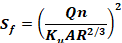

Where:
• = Discharge
• = Manning's roughness coefficient
• = Cross-sectional area of flow
• = Hydraulic radius
• = Unit conversion factor (1.486 for US Customary units, 1.0 for SI units)
Note: For pipes flowing partially full, the engine calculates and based on the normal depth of flow. If the computed HGL exceeds the pipe crown, the full-flow area and hydraulic radius are utilized.
Copyright © 2026 CivilFX, LLC